


A road-themed playground can turn an ordinary play area into a place for imaginary bus trips, delivery rounds and journeys to familiar destinations. For Australian schools and council parks, however, the right equipment needs to offer more than an appealing streetscape. Playtec helps buyers explore suitable playground options, but the purchasing decision should start with the intended play experiences, available space and needs of the children who will use the equipment.
Choosing the right setup means assessing interactive features, deciding whether wheeled play belongs in the design and ensuring pretend routes remain distinct from real vehicle areas. These considerations help compare proposals on practical value, rather than appearance alone.
What Would I Want a Pretend Road Setting to Achieve?
Start by identifying the experiences the equipment should support. A clear purchasing brief might prioritise imaginative journeys, shared storytelling, role-play or opportunities for children to interact with one another.
The intended age range, expected number of users and pattern of use will influence the design. A playground used by a familiar school group may support different activities from a public park shared by children of various ages. Defining these requirements early makes it easier to assess whether a supplier's proposal suits the setting.
The NSW Government’s inclusive playspace design guidance can help buyers consider varied play opportunities, community needs and site characteristics when preparing their brief.
Pretend Journeys and Everyday Community Roles
A road-themed playground can draw on experiences children recognise without prescribing a single way to play. A steering element might suggest a bus driver, while a destination graphic could inspire a delivery journey or an imaginary expedition.
Consider how children can participate beyond operating the pretend vehicle. Passengers, travellers waiting at a stop and people receiving deliveries can all contribute to the same story. When reviewing a proposal, look for opportunities for several children to participate without everyone needing to use the same component.
A balanced design combines recognisable features with open-ended possibilities. Too few visual cues may leave the equipment feeling disconnected, while an overly specific theme can restrict the stories children invent. A small number of meaningful prompts may provide more flexibility than a large collection of decorative signs.
The brief should also identify the intended age group and expected level of independence. Ask whether children can understand and use the features without constant adult direction and whether the layout accommodates different ways of participating. Playtec's article on choosing equipment for school environments provides additional considerations for school buyers.
Play Opportunities Rather Than Promised Road Safety Outcomes
Pretend journeys can encourage conversations about familiar places, travel and everyday community roles. However, the presence of miniature roads, signs or crossings does not establish that playground equipment teaches children how to behave safely around real traffic.
Keep the purchasing objectives focused on the play experience. Assess whether children can invent different journeys, share roles and revisit the features with new ideas. If a supplier promotes road safety benefits, ask what specific outcomes are claimed and what evidence supports them.
A miniature streetscape does not replicate vehicle speeds, visibility limitations or unpredictable traffic movements. It should not be treated as a substitute for structured road safety education or practical instruction suited to children's ages.
A clear procurement brief can therefore focus on engaging imaginative play, appropriate equipment and a layout suited to the intended users. Any additional educational claims should be considered separately and supported by relevant evidence.
Equipment That Gives the Theme Something to Do
A road theme becomes more useful when its features encourage action, interaction or storytelling. Graphics can establish the setting, but buyers should also consider what children can do within it.
Steering elements, destination graphics and pretend service points are examples of concepts to discuss with suppliers. Before including any feature in a specification, verify its availability, configuration and suitability for the proposed environment.
Interactive Features Versus Decorative Road Graphics
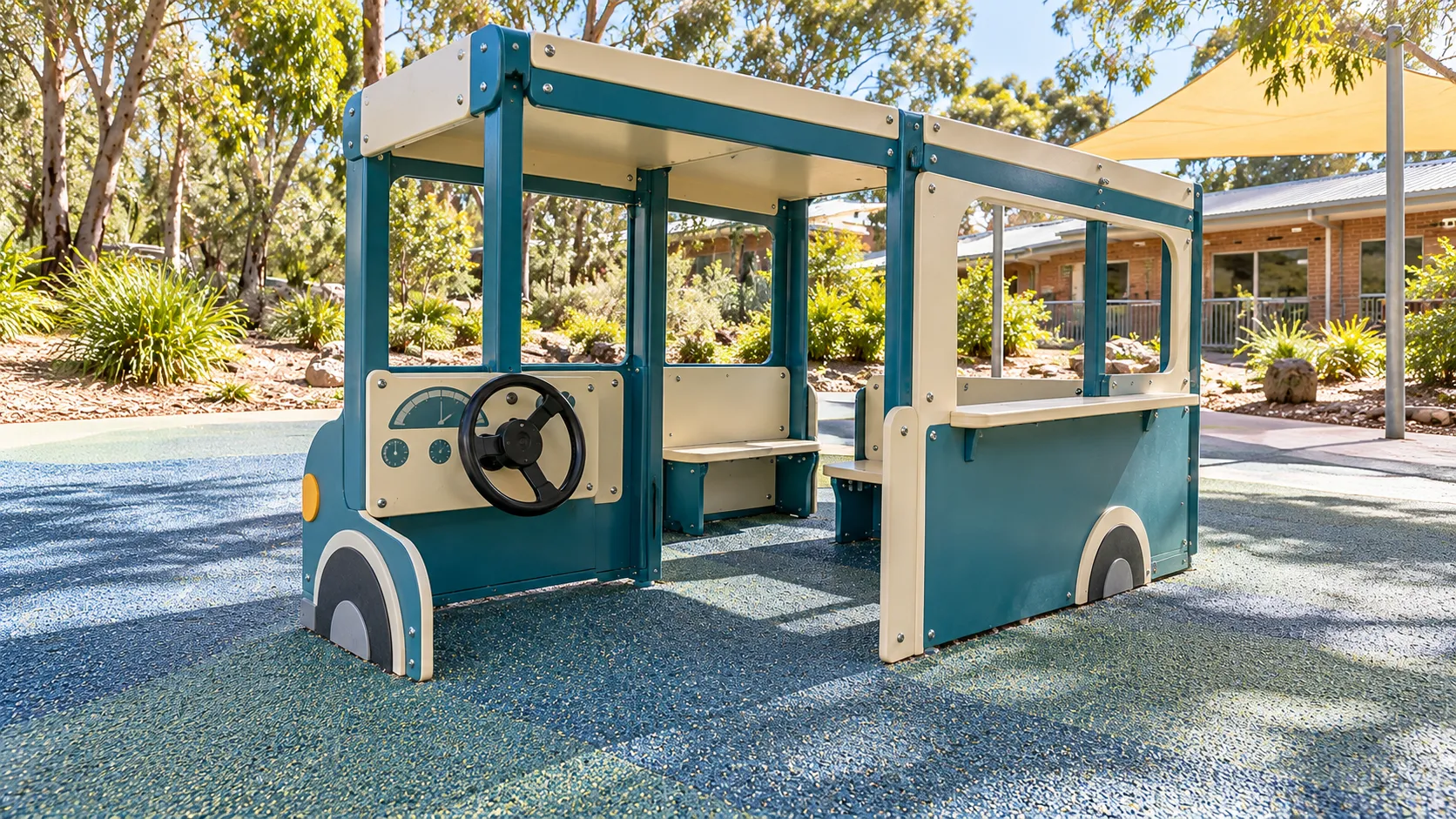
For each proposed feature, identify the activity it supports. A steering element might encourage children to operate a pretend vehicle, while a destination panel could prompt them to choose where to travel. A pretend service point might support an exchange between a traveller and someone helping them.
Decorative road graphics serve a different purpose. They establish the theme and help children interpret the setting, but they may not offer an activity on their own. Both types of features can contribute to the design, provided the proposal balances visual appeal with meaningful play opportunities.
When assessing interactive components, consider whether children can use them independently, whether several children can participate and whether the activity remains interesting beyond an initial encounter. Fixed features can support imaginative play when their purpose is clear, while moving parts are not automatically more engaging.
Repeated use also matters in a commercial playground environment. Ask the supplier about component durability, inspection schedules, maintenance needs and any moving parts that require attention. These details help buyers consider the ongoing demands of the equipment alongside its initial appeal.
This article on features worth assessing before purchase offers further considerations when comparing commercial playground equipment.
Connected Play Prompts Rather Than Isolated Props
Individual features are more likely to support a coherent play experience when they work together. A departure point, a destination cue and a place for a pretend exchange can suggest a complete journey without requiring children to follow a fixed sequence.
Review the proposal as a series of possible experiences rather than a catalogue of themed objects. Can a child begin a journey, invite another child to join and arrive somewhere with a reason to continue playing? Does the destination offer another role or activity, or does the story end as soon as the child reaches it?
Flexibility is equally important. A pretend service counter might become a ticket desk in one game and a delivery point in another. Look for features that allow children to change the story instead of limiting them to a single scripted activity.
When comparing quotations, assess whether each proposal offers similar opportunities for interaction and imaginative play. Request an itemised breakdown that distinguishes included equipment from decorative treatments and optional extras. Where relevant, compare delivery, installation, surfacing and maintenance requirements as well.
This approach makes it easier to determine whether a higher-priced proposal provides additional play value or simply includes more themed components.
How Do I Decide Whether Wheeled Play Belongs Here?
A pretend road setting and a riding circuit are different design propositions. Children can create journeys and community stories on foot, so bikes and scooters are not essential to a road-themed playground.
If wheeled play is part of the brief, identify that requirement before selecting equipment. Riding introduces different movement patterns and space requirements that need to be considered alongside stationary activities. Adding a riding route after the fixed equipment has been selected may create avoidable design conflicts.
A Road Theme Does Not Require Bikes or Scooters
Children can pretend to travel while standing at a steering feature, moving between destinations on foot or taking turns as passengers and service-point attendants. The journey exists through imaginative play rather than actual vehicle movement.
If the main objective is shared role-play, wheeled equipment may not add enough value to justify the extra space and planning it requires. A walking-based layout may also make it easier for children to gather around popular features without competing with passing riders.
Ask suppliers to explain how the proposed equipment supports play without bikes or scooters. Consider which activities remain available, how children move between features and whether the theme makes sense as a fixed role-play setting.
Keep the supply arrangements clear. A road-themed proposal does not mean bikes or scooters are included, suitable for the site or supported by the supplier. The specification should state which items are being provided and whether the design is intended to accommodate wheeled use.
Different Space Demands for Walking and Riding
Walking-based play still requires sufficient room for circulation, access and children gathering around popular features. Riding introduces additional considerations, including speed, turning movements and potential conflicts between moving and stationary users.
The equipment footprint alone does not establish how much space the complete play area needs. Buyers should also consider the routes children will take, access to individual features, surrounding activities and the relationship between different movement patterns.
If riding is proposed, arrange a site-specific assessment with a playground designer before committing to the layout. The assessment should consider the intended users, proposed wheeled equipment, available space and how riding movements can be managed in relation to stationary play.
Operating arrangements may also affect the design. A school might propose defined periods for different activities, while a council park may need to accommodate children arriving with different equipment and using the area concurrently. Any assumptions about supervision or separate use periods should be made explicit rather than treated as automatic safeguards.
This discussion on assessing space for indoor play equipment may be useful for indoor proposals, but it should not be used to determine the dimensions of an outdoor riding circuit. Request a plan that clearly distinguishes the equipment footprint from the additional space needed for movement, access and surrounding activities.
A Pretend Streetscape With a Clear Boundary
The road theme should remain clearly within the designated play area. Graphics and movement cues should not suggest that an imaginary journey continues into a car park, driveway or access road.
Consider this relationship while reviewing the concept, before equipment and installation arrangements are finalised. A professional can assess the proposed layout against the actual site conditions and identify concerns that may not be apparent in a product illustration.
Keeping Play Routes Distinct From Car Parks and Access Roads
Review the proposed layout from a child's perspective. A painted route ending at an opening might appear to continue beyond the play area. Similarly, a pretend entrance facing a driveway could suggest that the next destination lies in a space used by real vehicles.
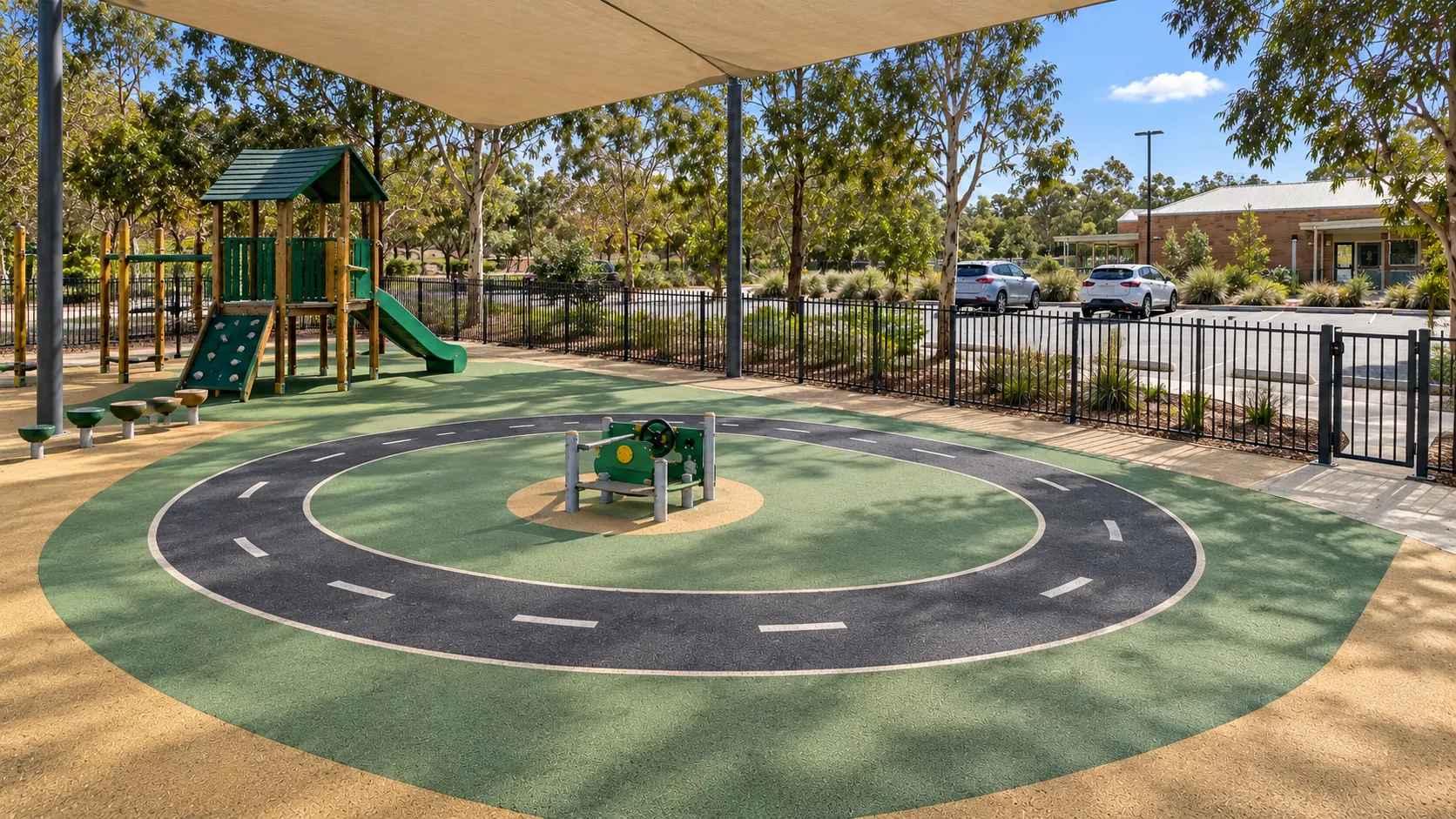
The concern is not limited to painted lines. A sequence of destination markers, directional graphics or the orientation of a feature may also draw attention towards a vehicle access point.
Ask the designer to identify where pretend routes begin and end, how the boundaries are communicated and whether the layout could create ambiguity for children. Existing fences, gates, paths and vehicle movements should be assessed in context rather than assumed to resolve the issue.
A graphic or small sign should not be treated as a substitute for appropriate site planning. The suitable approach depends on the location, surrounding traffic movements and proposed activities. Any physical separation or additional boundary measures should be determined through the relevant site assessment.
For supplier comparisons, request a layout showing the equipment's position, the direction of its play features and its relationship to nearby vehicle areas. Close-up product photographs may demonstrate visual appeal, but they cannot establish whether the complete layout is suitable for the proposed site.
Graphics That Make Sense in an Australian Setting
Locally recognisable imagery can help children understand a pretend streetscape. Familiar destinations and coherent road-related symbols may establish the theme more readily than a mixture of unrelated visual styles.
Ask to review the proposed artwork rather than relying on a general description such as traffic signs. Check that the destinations, symbols and colours work together as part of a consistent theme. The aim is to create a setting children can interpret, not necessarily to reproduce every detail of a real street.
Miniature signs and road markings should remain clearly understood as play features. Their resemblance to real traffic signs does not establish that they comply with traffic regulations or perform a formal traffic-control function. Supplier descriptions should preserve this distinction, particularly when the equipment is intended for educational environments.
Before purchasing, confirm that the proposed materials, components and installation arrangements suit the specific school or park. Outdoor exposure, expected use and maintenance requirements should be considered rather than assuming that equipment suitable for one environment will work equally well in another.
Playtec can help buyers explore available commercial playground equipment options based on their intended users, site conditions and preferred play opportunities. By comparing the actual features, installation requirements and ongoing maintenance needs, schools and councils can decide about whether a road-themed setting is right for their space.


