

Designing an indoor commercial play space starts long before choosing slides, climbing frames and interactive panels. One of the most important early decisions is determining how much room is actually required for the chosen equipment, age groups, customer flow and venue goals. If space planning is handled poorly, the result can be overcrowded layouts, limited play value, difficult supervision and increased safety risks. With the right planning, commercial playground equipment can fit safely and efficiently within the available footprint while still supporting strong customer flow and long-term business value.
Playtec explains how equipment footprints, safety clearances, circulation routes, ceiling heights and support spaces all affect the true amount of room needed for an indoor playground. Venue type, capacity targets, age zoning and supervision requirements also influence how much usable space should be allowed. By considering these factors early, indoor play projects can avoid costly redesigns and create a safer, more engaging and practical environment.
How Venue Type Changes the Space Needed
The type of venue has a major influence on how much floor area and overhead clearance an indoor playground requires. Different sites have different visitor patterns, supervision needs, dwell times and secondary uses such as dining, retail, parties or education. These factors affect how much space can be dedicated to play and how much must be reserved for circulation, seating, queuing, storage and amenities.
Understanding these differences helps align the play space with safety expectations and commercial goals. A structure that fits comfortably in a large adventure park may feel cramped or impractical in a compact café, childcare centre or community venue.

Family Entertainment Centres and Adventure Parks
Family entertainment centres usually cater for longer visits, higher visitor numbers and a wider range of ages. As a result, they often need larger play zones, generous walkways and strong separation between high-energy activities and quieter areas.
Large multi-level soft play structures may take up a significant portion of the available floor area, but enough room still needs to be allowed for party rooms, seating, dining, queuing and circulation. Wider walkways are especially important around entrances, exits and popular features where children and carers naturally gather. Ceiling height is also critical, as taller slides, climbing towers and netted walkways need enough overhead clearance to remain safe and comfortable.
Trampoline and adventure-based venues need even more open, unobstructed space around high-energy features. Foam pits, air bags, performance trampolines and climbing activities require suitable run-off areas, clear supervision points and adequate clearance from ceilings, lighting and overhead services.
Hospitality Venues
Hospitality venues usually work with tighter footprints because dining, ordering and customer movement must remain the priority. Play areas in cafés, pubs and clubs are often more compact, so the design needs to deliver good play value without taking over the venue.
In smaller hospitality settings, the play zone may only occupy a modest portion of the floor area. This means low-level structures, soft play, interactive panels and compact vertical designs are often more suitable than large adventure-style equipment. Clear sightlines from seating are essential so parents and carers can supervise children without needing to stand in walkways.
Noise, crowding and access also need careful thought. A clear buffer around the play entry helps contain shoes, bags and waiting children, while keeping aisles open for staff and other customers. The playground should feel connected to the venue without interrupting dining areas, service counters or main circulation routes.
Schools, Nurseries and Community Centres
Education and community venues usually prioritise developmental value, accessibility and flexibility rather than maximum play capacity. These spaces may be shared with other activities, so the playground layout needs to work within existing room uses, fire exits, corridors and supervision requirements.
In nurseries and early years settings, lower fall heights reduce the need for tall structures, but younger children often need more open floor space, wider access routes and room for adult supervision. Equipment should feel secure and easy to monitor, with enough separation from older or more active children.
Schools and community centres may also have stricter requirements around emergency access and multi-use spaces. The effective area available for play can be smaller than the gross room size once exits, wall access, storage and group movement are considered. In these settings, compact play clusters, sensory panels, low-level climbing and flexible layouts are often more practical than large fixed structures.
Start With Usable Floor Area, Not Total Room Size
The starting point for any indoor commercial playground is the actual usable space, not just the room’s overall dimensions. A room may look large on paper, but the available play area can shrink quickly once columns, low ceilings, fire doors, windows, radiators, service areas, door swings and fixed furniture are taken into account.
Ceiling height is just as important as floor area. Multi-level play frames can increase play value within a smaller footprint by stacking activities vertically, but they still need appropriate headroom above platforms, slides and climbing routes. In lower spaces, it is often better to use a wider, lower layout rather than trying to force too much height into an unsuitable room.
The shape of the room also matters. Long, narrow spaces may limit circulation and sightlines, while irregular spaces may require custom layouts to avoid awkward corners or dead zones. Early measurement should include floor area, ceiling height, access points, obstructions, emergency exits and the likely location of seating, storage and amenities.
Allow for Safety Zones, Fall Areas and Clear Access
The footprint of the equipment is only one part of the total space required. Every elevated platform, slide, climber or high-energy feature needs clear space around it so children can move, fall, enter and exit safely. These safety zones must remain free from walls, posts, benches, windows, radiators, furniture and other equipment.
As a practical planning guide, elevated equipment and slide exits often require generous clearance around the structure, with larger safety envelopes needed for more dynamic features such as overhead climbers, spinning activities or trampoline-style elements. The exact space required will depend on the equipment design, fall height, surfacing and relevant safety standards.
Slide run-outs, climbing access points, ball pits and active play entries all need special attention because children naturally gather in these areas. A slide may have a compact footprint, but the run-out area at the base can increase the true space needed. Similarly, a ball pit, trampoline bay or climbing tower needs enough surrounding space to separate active play from walkways and quieter zones.
Circulation routes should also be planned separately from fall zones. Main traffic paths should not run directly in front of slide exits or through high-impact areas. Keeping clear access around the structure allows carers to move freely, staff to respond quickly and children to enter and leave activities without creating bottlenecks.
Match Equipment Size to Capacity
Once the usable space and safety zones are understood, the equipment size should be matched to the expected number of children using the area. A compact playground filled with too many high-capacity features can quickly become congested, reducing play quality and making supervision more difficult.
Capacity planning should consider the venue’s busiest periods, not just average use. A café may only need a small play area during quiet periods, but weekend family traffic could create pressure around entries, seating and popular play features. A family entertainment centre may need multiple access points, wider walkways and separate zones to spread children across the space.
In some cases, modular low-level equipment, soft play blocks, sensory panels and smaller slides can provide better value than one large dominant structure. In larger venues, a main play frame can be supported by smaller play pods for toddlers, sensory activities or quieter play. This helps distribute activity across the venue instead of concentrating every child in one area.
Planning for Different Age Groups
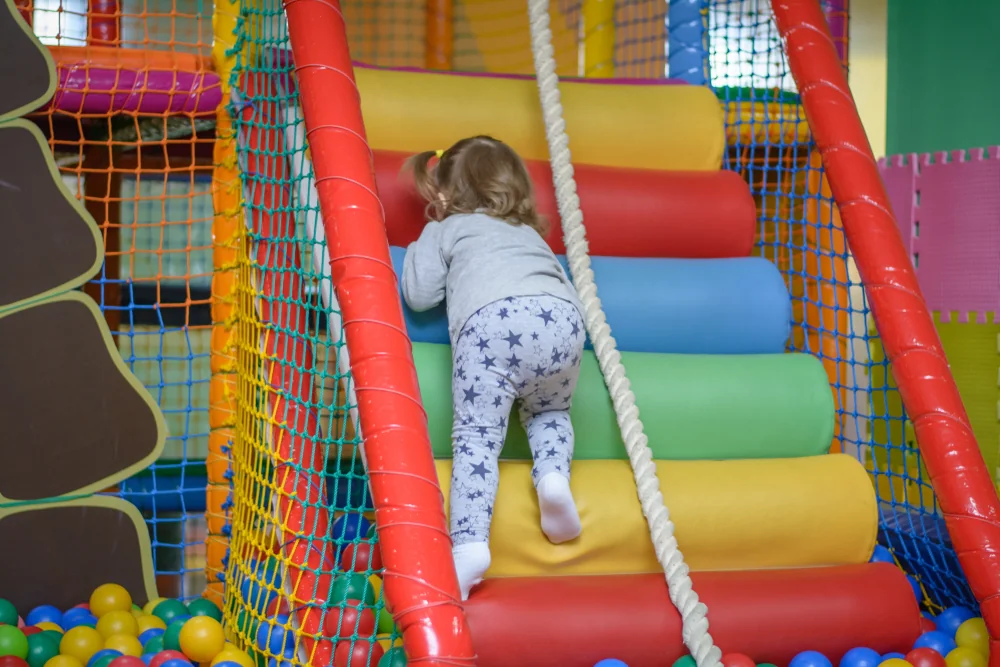
Indoor playgrounds work best when each age group has space that feels safe, engaging and not overcrowded. Toddlers, preschool children and older children use play equipment differently, so they should not be forced into the same high-energy zone without separation.
Toddlers need softer, slower and more contained play experiences. Older children usually seek height, speed, climbing challenges and social interaction. When these activities overlap too closely, younger children can feel overwhelmed and older children may become restricted by a layout that does not suit their energy levels.
Age zoning helps prevent these conflicts. A toddler zone may sit near seating with low barriers or soft fencing so carers can supervise easily. More active equipment can then be placed further inside the layout, with clear entry points and enough space for children to queue, move and exit safely.
Good age zoning should still maintain open sightlines. Staff and carers need to see across the play space, even where children cannot run directly between zones. Clear signage at each entrance also helps guide families towards the most appropriate area for each child’s age and ability.
Making the Playground Work With Customer Flow
An indoor commercial playground should support the way families move through the venue, not disrupt it. The layout needs to guide customers naturally from the entrance to play, seating, amenities and exits without forcing people through active play zones or narrow pinch points.
The playground should be visible enough to attract families, but not positioned where it blocks main circulation routes. In many venues, the best location is near family seating, set back from the entrance and away from service counters, payment points or kitchen pathways. This allows families to find the play area easily without creating congestion at the front of the venue.
The entry to the play zone also needs enough open space for practical use. Families need room to remove shoes, store belongings, read rules and organise children before entering. If this space is too small, people end up standing in walkways, blocking access or crowding around the equipment.
Seating, storage and supervision points should be planned as part of the layout rather than added later. Adult seating works best when it has clear sightlines to key play areas without encroaching into fall zones or access paths. Shoe racks, pram parking and bag storage should sit to the side of the play entry rather than directly in front of it. These small layout decisions can make the whole venue feel calmer, safer and easier to manage.
Factoring in Support Spaces
The room needed for an indoor commercial playground also includes the spaces around the equipment. Depending on the venue, this may include seating, toilets, pram parking, bag storage, party rooms, reception areas, café seating, staff access, cleaning access and emergency routes.
These support spaces affect the success of the playground just as much as the equipment itself. A play structure may technically fit within the room, but if there is not enough space for adults to sit, children to queue, staff to supervise or families to move around comfortably, the layout will not function well during busy periods.
Maintenance access should also be considered early. Equipment may need regular cleaning, inspection and repairs, so staff need safe access to panels, netting, platforms, flooring and enclosed sections. Leaving no practical maintenance space can make routine upkeep harder and increase long-term operational issues.
The amount of room required for an indoor commercial playground depends on far more than the dimensions of the equipment itself. Successful layouts account for usable floor area, ceiling height, safety zones, circulation paths, customer flow, age separation, supervision sightlines, support spaces, emergency access and maintenance needs.
When these factors are considered from the earliest planning stage, the result is a play environment that feels spacious, functional and safe. Careful space planning also helps the playground support the wider venue, giving families a more comfortable experience while helping the business make better long-term use of its available floor area.


.svg)

