

Relocating or reconfiguring an existing indoor playground is a decision for any operator. Whether moving to new premises, refreshing an outdated layout, or responding to changing safety requirements, the process requires careful planning to decide what to keep and what to change.
The condition and design of the existing playground equipment, along with the new space, can all affect whether relocation is practical. Ceiling heights, access routes, floor plans, safety clearances, installation requirements and potential downtime need to be considered before work begins.
Playtec helps operators understand the practical considerations involved in relocating or reconfiguring a play area. Assessing these factors early can help businesses protect their investment, manage costs and create a safe, engaging environment for families.
When Relocating or Reconfiguring a Playground Makes Sense
Relocating or reconfiguring an indoor playground can be more practical and cost-effective than replacing the entire installation, provided the existing structure is suitable for reuse. The decision depends on the equipment's condition and age, how well it suits the new space and whether the redesigned playground can meet current safety requirements.
Operators should carefully assess whether it is more practical to refurbish or replace playground equipment before committing to relocation, particularly when safety, accessibility and long-term maintenance costs are involved.
Reconfiguration or relocation may be worth considering when:
- The business or customer base has changed: Existing equipment may still be structurally sound but no longer suit the target age group, visitor expectations or new revenue streams.
- The premises or floor plan has changed: Moving to a new site or altering an existing venue may create an opportunity to rearrange modular structures and improve circulation, visibility and use of the available space.
- The equipment remains in good condition: Steel frames, platforms and other components are more likely to be suitable for relocation when they show no significant corrosion, cracking, deformation or structural fatigue.
- Targeted upgrades are possible: If only certain components, such as surfacing, netting, barriers or individual play features, need attention, selective replacement may be more practical than starting again.
- The new space is suitable: Ceiling height, floor area, access routes and structural constraints need to accommodate the existing installation and its required clearances.
A playground specialist should assess the existing structure before any decision is made. If deterioration is present or extensive modification and replacement would be required, a new playground may provide better long-term value.
Assessing the Existing Playground Before Relocation
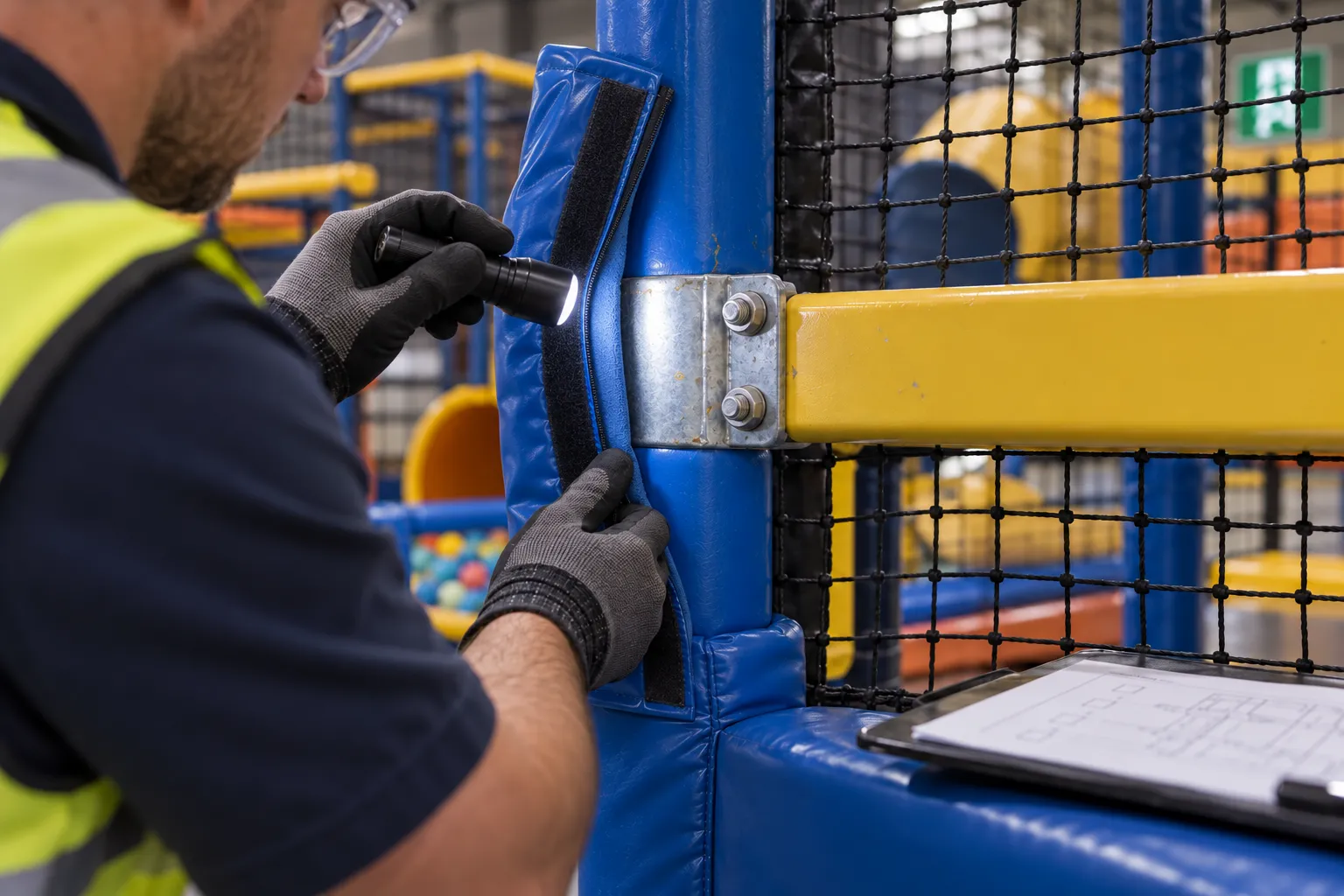
Before dismantling begins, operators should establish whether the existing structure and components are suitable for reuse. A pre-relocation assessment can identify structural damage, worn parts and potential compliance issues before equipment is transported or reinstalled.
The assessment should cover the complete installation, including the main frame, connections, platforms, barriers, netting, slides, padding, surfacing and other components that contribute to safe operation.
Check the Structure
Steel posts, beams, brackets, welds, anchors and connection points should be checked for corrosion, cracking, deformation and excessive wear. Attention should be given to areas subject to repeated loading or movement, including platform supports, floor fixings and slide mounting points.
Any deterioration should be reviewed by an appropriately qualified professional before relocation proceeds.
Review Age and Records
Manufacturer information, installation records, engineering documentation, inspection reports and maintenance records can help establish the equipment's history and suitability for reuse.
Previous repairs or modifications should also be identified because changes to the original design may affect structural capacity, compatibility and the availability of replacement components.
Record the Equipment
Before dismantling, major components should be photographed, labelled and recorded along with their condition and intended location in the new design. This helps identify missing or damaged parts early and makes reassembly more straightforward.
The assessment should ultimately classify components as suitable for reuse, requiring refurbishment or modification, or unsuitable for the new installation.
What Equipment Can Be Reused in the New Setup?
A portion of an indoor playground can often be reused when components remain in good condition, are compatible with the new design and can satisfy applicable safety requirements. Modular systems are adaptable because sections can often be dismantled and rearranged.
Well-designed flexible modular playgrounds can make reconfiguration easier because compatible sections may be repositioned, expanded or adapted to suit a different commercial space.
However, components should not be reused simply because they appear visually sound. Padding may have lost its protective properties, netting may be worn and fixings may have deteriorated. Each component should be assessed for condition, compatibility and suitability for the proposed configuration.
Where flooring, padding or other impact-attenuating materials are reused, their condition and protective performance should be considered carefully. Critical fixings and hardware may also need replacement rather than being reused.
Planning for Access and Transport
Once the equipment has been assessed, the physical relocation needs to be planned. Large components may be difficult to remove from the existing premises or bring into the new site, particularly where access involves narrow doorways, corridors, stairs or lifts.
Before dismantling, operators should check:
- Door and corridor dimensions
- Lift sizes and weight limits
- Stairways and changes in floor level
- Loading and vehicle access
- Ceiling clearance along transport routes
- Building or landlord restrictions
Dismantling should be systematic, with components labelled and photographed as they are removed. Smaller fixings should be stored securely with the relevant sections, while slides, netting, acrylic panels and decorative elements should be protected during transport.
The new premises should also be prepared before equipment arrives. Flooring, electrical work, lighting, ventilation and other building works should be completed or coordinated in advance. Planning these details early can reduce storage costs, delays and damage to reusable components.
For a commercial venue, the schedule should also account for downtime. Replacement parts should be ordered early and sufficient time should be allowed for dismantling, transport, site preparation, reassembly and final inspections.
How the New Space Affects the Playground Layout
A new premises rarely has the same dimensions or layout as the original site, so existing structures may need to be repositioned, modified or selectively replaced. Ceiling height, floor area, structural features, entrances and circulation routes all influence how the playground can be arranged.
Before equipment is moved, the new space should be measured and assessed to determine how the existing structure can fit while maintaining appropriate clearances, visibility, access and usable play space.
Here are some layout considerations:
- Physical constraints: Ceiling height is important for multi-level structures, slides and climbing features. Beams, columns, bulkheads, windows, vents and structural supports can also restrict where equipment can be positioned.
- Entry and circulation: Entrances, exits, shoe storage and waiting areas should be arranged to minimise congestion. Internal routes should allow children and staff to move safely between activities without obstructing emergency exits or access paths.
- Activity and facility zoning: Different age groups and activities may need to be separated to reduce congestion and potential collisions. Toddler areas may work better near seating, while high-energy activities can be positioned away from quieter zones.
Where relocation involves new building work or alterations to existing premises, the Access to Premises Standards may need to be considered when planning entrances, circulation routes and accessible facilities.
A careful assessment of the premises helps determine which existing components can be transferred as-is, which need modification and where replacement may provide a better fit.
How Relocation Can Affect Safety and Capacity
Relocating a playground can affect how children move, play and interact with the space, even when the same equipment is retained. Changes to the configuration can alter fall zones, circulation, supervision and the number of children who can safely use the facility.
The original capacity and operating arrangements should therefore not automatically be carried over to the new site.
Consider the following:
- Safety and supervision: Moving slides, climbing features and platforms can change fall zones and exit points. Equipment that was adequately separated at the original premises may be too close to another activity, wall or circulation route after relocation.
- Capacity and crowd flow: Capacity depends on more than floor area. The type and arrangement of equipment, circulation space, age groups and supervision requirements should all be considered. A smaller site may require a lower capacity, while a larger premises may provide scope for additional activities.
- Age and activity separation: Toddler areas and high-energy activities may need greater separation to reduce congestion and potential collisions. Existing age recommendations should also be reviewed if the configuration or access to an activity changes.
- Operating requirements: Maximum occupancy, admission limits, staff supervision procedures, entry and exit arrangements and safety signage may need to be updated to reflect the new configuration.
Reassessing these factors helps operators create a safer and more manageable environment rather than simply reproducing the previous layout in a different space.
When Equipment Needs to Be Modified or Replaced
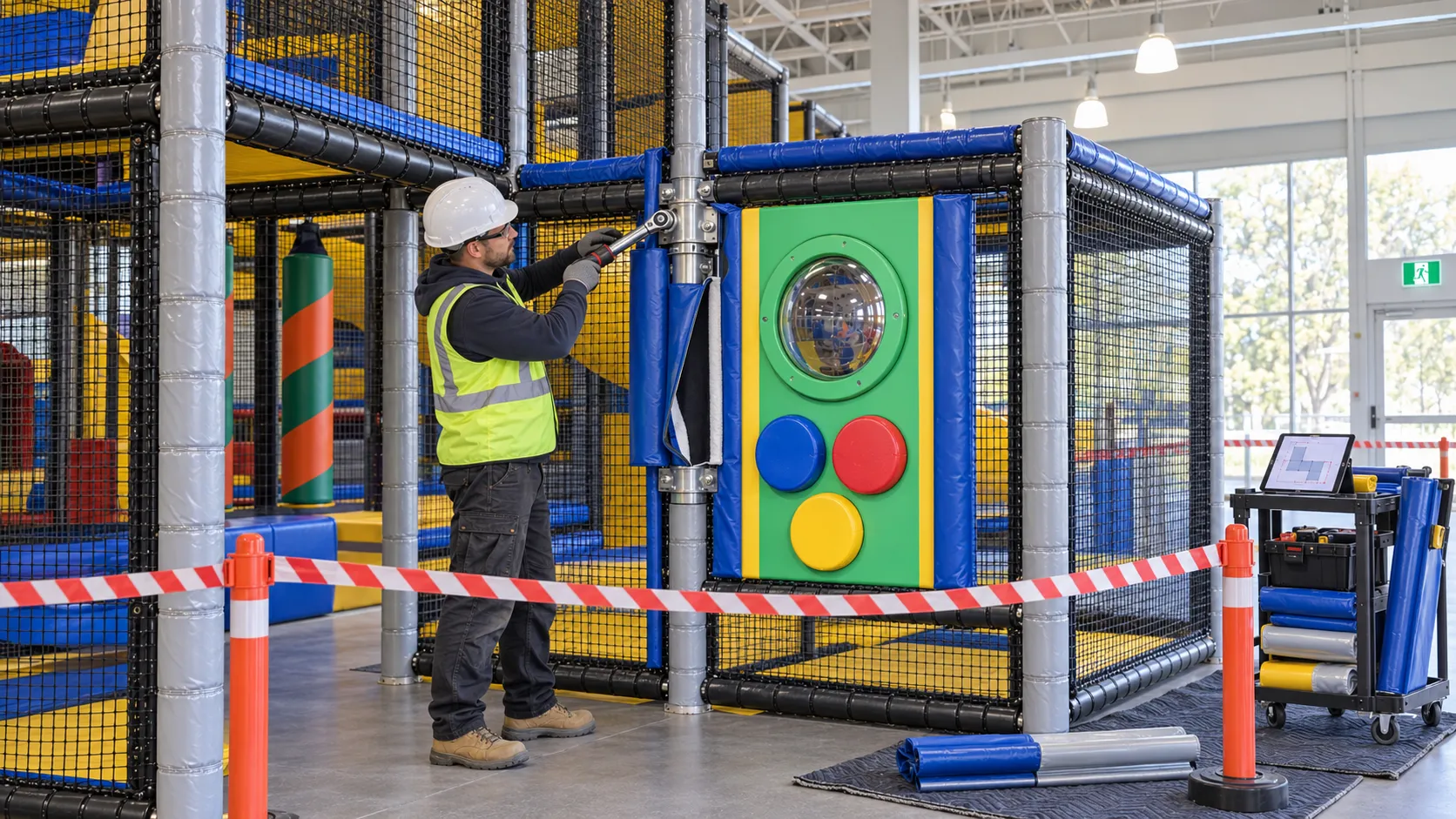
Not all existing equipment needs to be replaced during a relocation or reconfiguration. Sound components may be modified or upgraded, while worn or unsuitable elements can be replaced individually. The appropriate approach depends on the condition of the equipment, applicable safety requirements and its suitability for the new design.
Modify
Modular structures can often be adapted by changing platform configurations, entry and exit points, barriers, netting or play features. Sections may be repositioned, removed or added where the system has been designed to allow such changes and structural integrity is maintained.
Any modification should be reviewed against the manufacturer's specifications and applicable safety requirements to ensure it does not affect structural stability, fall zones, access or other safety features.
Replace Parts
Partial replacement can be practical when the main structure remains sound but individual components have reached the end of their useful life. Padding, flooring, netting, plastic slides and rope elements may require replacement because of damage, deterioration, hygiene concerns or changing requirements.
New components must be compatible with the existing structure and installed in accordance with appropriate technical and manufacturer requirements.
Replace Entire Elements
Corrosion, damaged connections, structural deformation or fatigue may indicate that an element should be replaced rather than repaired. Replacement can also make more sense when equipment no longer suits the intended age groups, capacity or business model.
Where extensive modification would be required, operators should compare the cost and complexity of adapting the existing installation with the benefits of a new system designed specifically for the premises.
Budgeting for Playground Relocation or Reconfiguration
Relocating or reconfiguring an indoor playground involves more than dismantling and transport. Labour, site preparation, replacement components, inspections, reinstallation and building works can all affect the final cost.
A relocation budget may need to allow for:
- Dismantling and reinstallation labour
- Transport, loading and temporary storage
- Site preparation and building works
- New fixings, brackets or structural components
- Replacement padding, flooring, netting and play features
- Design or reconfiguration costs
- Engineering and inspection services
- Updated signage and safety equipment
- Electrical, lighting, ventilation or other site works
Unexpected costs can also arise once equipment has been dismantled. Hidden corrosion, damaged connections, missing fixings or worn components may not be apparent during an initial assessment. Access problems or an unprepared site can create further labour and storage costs.
A contingency allowance can help manage these risks. Operators should also confirm that replacement parts are still available for older systems before committing to reuse.
The total relocation cost should then be compared with the age, condition and remaining service life of the existing installation. Reusing a sound frame may provide savings when only selected components need replacing, but extensive refurbishment or structural modification can make replacement a more attractive option.
Reinstallation, Compliance Checks and Sign-Off
After dismantling and transport, the playground must be carefully reinstalled and assessed before reopening. The completed installation should be checked against the approved design, manufacturer requirements and applicable safety obligations.
Installation should follow the planned layout, with structural components, platforms, slides, netting, barriers and other elements installed appropriately. Damaged or missing components should be replaced with suitable approved parts rather than improvised alternatives.
Before reopening, areas should be checked, including:
- Structural connections, fixings and anchors
- Fall zones, clearances and headroom
- Barriers, openings and potential entrapment points
- Access, exits and emergency routes
- Supervision sightlines and circulation
- Safety surfacing and impact protection
- Age recommendations and capacity limits
For Australian indoor playgrounds, the applicable requirements can depend on the type of equipment, its use and the state or territory in which the facility operates. Relevant Australian playground standards may include the AS 4685 series for playground equipment and surfacing and AS 4422 for playground surfacing, depending on the equipment and proposed use. Building, fire safety, accessibility, workplace health and safety and local requirements may also need to be considered.
Relocating or reconfiguring an indoor playground is about more than moving existing equipment from one space to another. The decision should consider structural condition, safety and compliance, the new layout, installation requirements, costs and the remaining value of the existing installation.
With careful planning and professional assessment, operators may be able to reuse sound structural elements while upgrading worn or outdated features to better suit a new space and customer needs. Playtec understands the importance of balancing safety, practicality and commercial value throughout this process. By assessing the existing playground, planning the new configuration and completing the inspections before reopening, operators can protect their investment while creating a safer and more engaging environment for families.


.svg)

