

Managing an outdoor play space often involves deciding whether existing equipment should be refurbished or replaced. The right approach can affect safety, long-term costs, accessibility, compliance and the overall experience provided to children and the wider community.
As a provider of commercial playground equipment, Playtec helps schools, councils and organisations assess when refurbishment may offer lasting value and when complete replacement is the more practical investment.
Before making a decision, asset owners should consider the condition of existing structures, previous maintenance, accessibility requirements, site constraints and the changing needs of users. A careful evaluation of lifecycle costs and future expectations can help organisations invest with confidence and create playgrounds that remain safe, engaging and fit for purpose.
Signs Your Playground Equipment Is No Longer Performing Well
Recognising when playground equipment is approaching the end of its useful life is an important part of managing safety, budgets and user experience. Equipment may still be standing and usable while no longer meeting contemporary expectations for accessibility, risk management or play value.
Identifying specific warning signs early can help determine whether targeted refurbishment is sufficient or whether replacement would provide better long-term value.
Visible Wear, Corrosion and Structural Deterioration
Surface deterioration is often one of the first signs that playground equipment is no longer performing as intended. Flaking paint, splinters, rust and worn finishes may be cosmetic, but they can also indicate deeper material or structural problems.
Metal components showing corrosion around joints, welds or fixings may have reduced strength. Timber that has split, warped, softened or decayed may have been affected by moisture ingress. Deep cracks, crazing or significant UV deterioration in plastic and composite components can indicate that the material is becoming brittle.
Wear concentrated around high-stress areas should be assessed carefully, even when the equipment still appears usable. Repeated temporary repairs to the same locations may indicate that the structure is approaching the end of its serviceable life.
Safety Issues That Recur Despite Maintenance
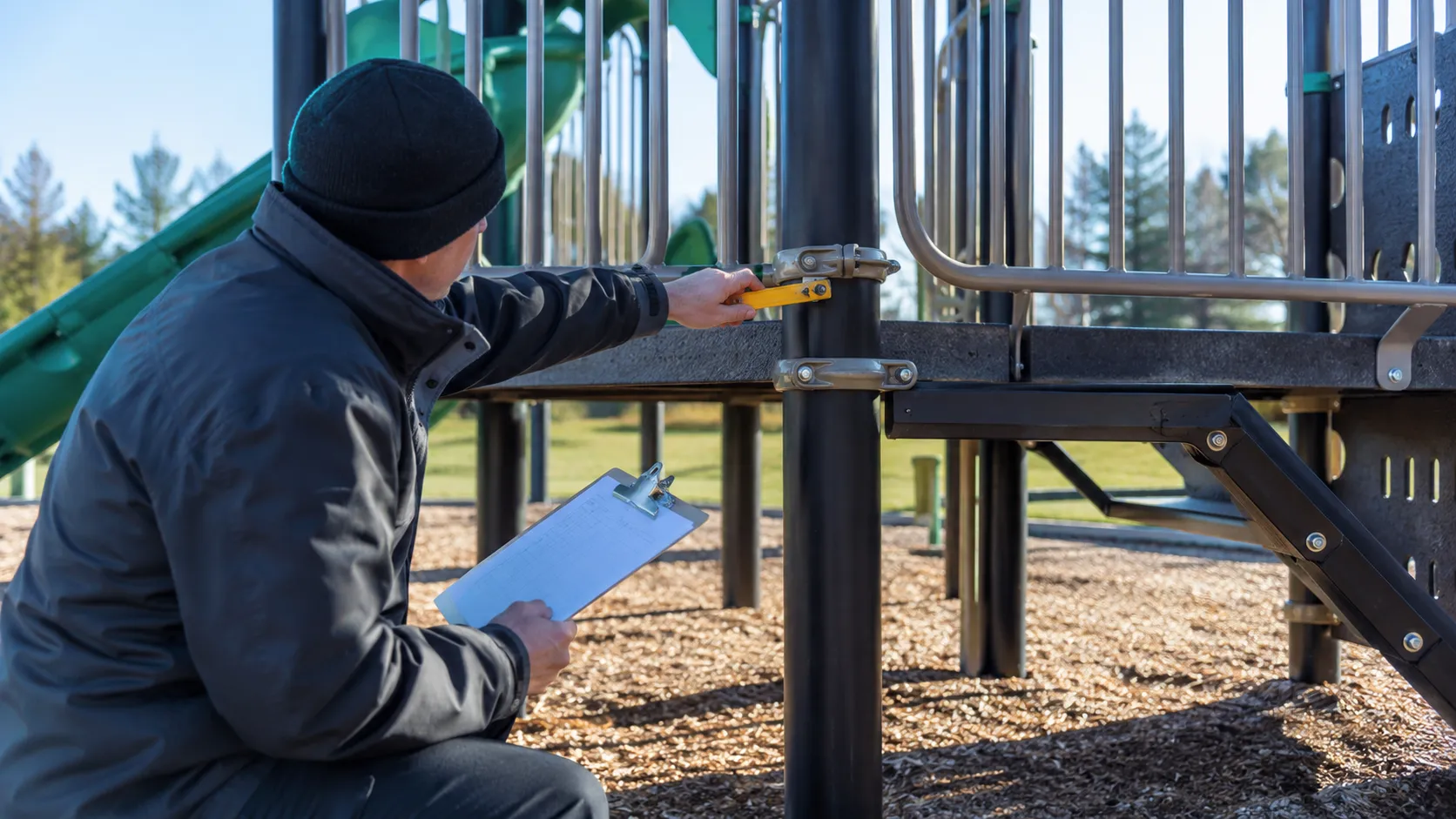
Equipment that repeatedly fails inspections may no longer be functioning effectively as a safe play facility.
Recurring concerns may include:
- Loose or missing fixings that continue to reappear
- Moving parts with excessive movement or misalignment
- Damaged barriers, handrails or guardrails
- Worn surfacing around frequently used fall zones
- Entrapment points or sharp edges that cannot be resolved through simple repairs
If inspection reports repeatedly identify safety concerns, further patch repairs may provide only short-term improvement. Ongoing remedial work can also increase lifecycle costs without resolving the underlying problem.
Feedback from users and supervising adults may provide additional warning signs. Reports of instability, repeated near-misses or children avoiding particular items should prompt a detailed inspection by a competent playground professional.
Reduced Play Value and Accessibility
Playground equipment can remain physically intact while no longer meeting the needs of its users.
A noticeable decline in engagement, long queues for only one or two features or children using equipment in unintended ways may suggest that the playground is no longer providing enough variety or challenge.
Older layouts may offer limited opportunities for imaginative, sensory, social or cooperative play. They may also be too difficult for younger children while providing too little challenge for older users.
Accessibility should also form part of the assessment. Routes that are difficult to navigate with wheelchairs, mobility aids or prams, along with a lack of play opportunities for children with different physical, sensory or cognitive needs, may indicate that a broader redesign is required.
Understanding how inclusive playgrounds differ from accessible play areas can help asset owners assess whether an existing layout merely provides access or supports meaningful participation and shared play.
When Refurbishment May Be Enough
Refurbishment can be a cost-effective way to extend the life of a playground when the main structures remain sound and identified safety concerns can be addressed through defined works.
A targeted upgrade may improve appearance, functionality and play value while reducing the disruption and material waste associated with complete replacement.
When Structures Are Sound but Tired
Refurbishment may be appropriate when posts, frames and foundations remain structurally stable and show no significant corrosion, cracking, decay or movement.
Suitable refurbishment projects may include:
- Recoating stable metal or timber frames
- Replacing scratched or damaged play panels
- Treating light surface corrosion
- Replacing worn ropes, fixings, caps or moving components
- Repairing minor vandalism or graffiti
- Renewing selected sections of playground surfacing
Sanding, surface preparation and high-performance coating systems can improve appearance and provide additional protection. Damaged components may also be replaced individually when compatible parts are available and the supporting structure remains suitable.
When Safety Issues Are Localised and Manageable
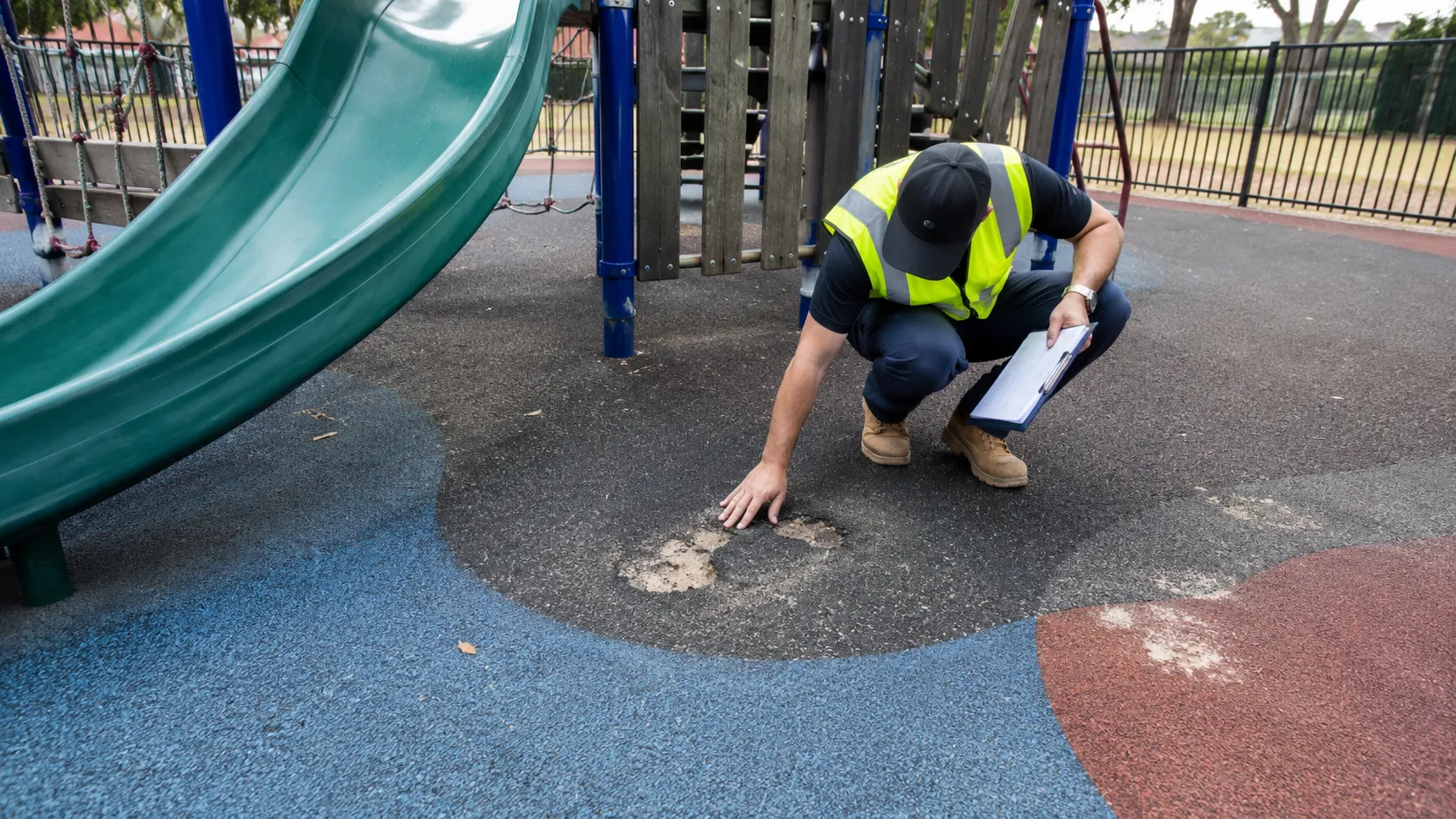
Refurbishment may be practical when safety concerns are limited to specific components rather than the entire playground.
This may apply when:
- Impact-attenuating surfacing is worn in isolated high-use areas
- Handrails, barriers or guardrails require upgrading
- Swing components or bearings need replacement
- Slide exits require modification
- Individual panels, platforms or fixings are damaged
- Loose-fill surfacing requires improved edging or containment
Where existing surfacing will be retained, playground surface impact testing may be required to confirm that the surface provides suitable impact attenuation for the equipment’s critical fall height.
A detailed condition and safety assessment should be completed before committing to refurbishment. This assessment should confirm that the visible concerns are not symptoms of more extensive structural or site-related problems.
A professional playground safety inspection can provide a clearer assessment of the equipment’s condition, surfacing performance and any corrective work required before it is returned to use.
Once the work is complete, a post-installation inspection should confirm that the upgraded equipment and surrounding play area are suitable for reopening under the applicable safety requirements.
Updating Older Playgrounds for Modern Play
Some playgrounds remain structurally reliable but no longer provide the variety of experiences expected from contemporary play spaces.
Modernising an existing playground may involve adding:
- Interactive or educational play panels
- Sensory features
- Nature-based play elements
- New climbing, balancing or coordination activities
- Inclusive play components
- Social seating and gathering areas
- Improved shade, landscaping or colour schemes
Where the underlying structures remain serviceable, selected component upgrades can improve functionality and extend the playground’s useful life without requiring a complete rebuild.
When Replacement Is the Safer Option
Refurbishment is not suitable for every playground. Full replacement may be necessary when structural integrity, accessibility, layout or ongoing maintenance requirements can no longer be addressed through targeted works.
Structural Damage and Material Fatigue
Once a primary load-bearing component has been significantly compromised, surface repairs or cosmetic improvements are unlikely to provide an appropriate long-term solution.
Replacement should be considered when:
- Posts or support frames show advanced corrosion, rust holes or deep pitting
- Welds are cracked or separating
- Platforms, bridges or towers move excessively during normal use
- Timber decay extends into structural sections
- Foundations are unstable or showing movement
- Multiple load-bearing components have reached the end of their service life
These problems may increase the risk of sudden failure. Temporary bracing or patch repairs may reduce immediate movement but are not substitutes for a reliable long-term solution.
Obsolete or Impractical Designs
Some older playground layouts cannot reasonably accommodate modern safety, accessibility or operational expectations without extensive reconstruction.
Replacement may be more appropriate when:
- Fall zones cannot be provided without major site alterations
- Barriers or guardrails cannot be upgraded without obstructing normal use
- Access routes cannot be improved to support inclusive use
- Platforms, slides or connections require extensive structural modification
- The equipment layout creates persistent congestion or supervision difficulties
- Replacement components are obsolete or unavailable
Adding numerous retrofitted barriers or components can also make equipment cluttered or confusing. A new installation can provide a more coherent design that accounts for safety, accessibility and play value from the outset.
When Repairs Become a Cycle
Routine maintenance is expected for every playground, but repeated repair work may eventually stop providing good value.
A lifecycle cost assessment can compare:
- The likely remaining service life of existing equipment
- Projected maintenance and inspection expenses
- The cost and frequency of replacement components
- Operational disruption caused by repeated closures
- The expected lifespan and maintenance requirements of a new installation
When the same components require frequent attention, replacement may offer more predictable costs and reduce the risk of unplanned closures.
Materials at the End of Their Service Life
Every playground material has a finite lifespan, even when it has been maintained correctly.
Signs that multiple materials are reaching the end of their service life may include:
- Widespread UV-brittle plastic components
- Cracking across several panels or platforms
- Extensive timber splitting, splintering or decay
- Hardened rubber components that no longer perform as intended
- Repeated coating failure across large structural sections
- Corrosion affecting multiple frames, joints or fixings
Replacing individual components may not restore the performance of the playground when deterioration is widespread. In these circumstances, a new installation may provide greater durability and more predictable performance.
Refurbishment or Replacement at a Glance
The decision to refurbish or replace playground equipment depends on the condition of the existing structures, the extent of required repairs and the long-term needs of the site. The following comparison highlights the main factors that can help guide the assessment.
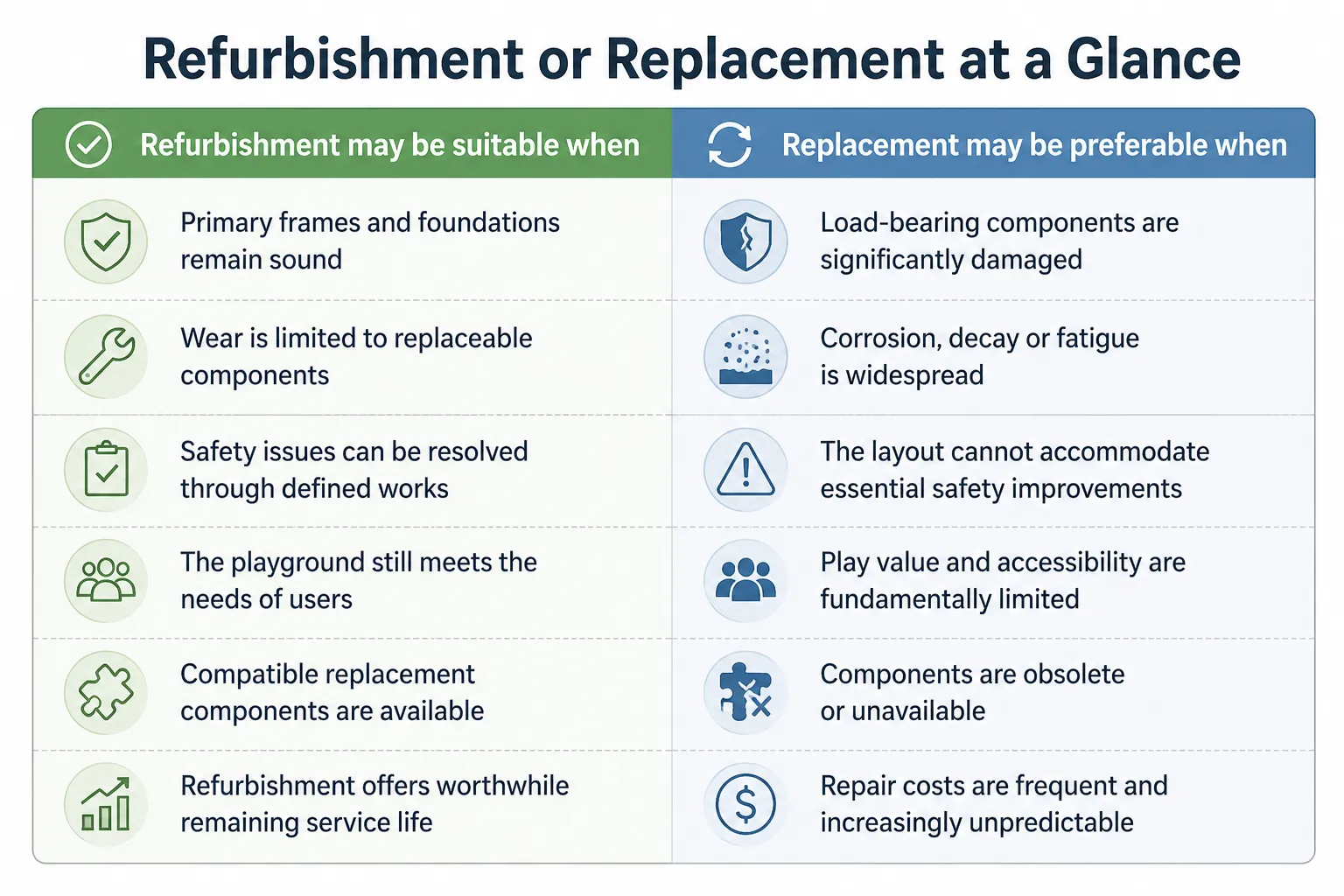
These factors should be considered together rather than in isolation. Equipment that appears suitable for refurbishment may still require replacement if structural deterioration, accessibility limitations or repeated maintenance issues reduce its long-term value. A professional condition and safety assessment can help confirm which option will provide the safest, most practical and most cost-effective outcome for the playground.
How Safety and Compliance Affect the Decision
Safety and compliance considerations should form part of the initial condition assessment rather than being reviewed only after a refurbishment or replacement strategy has been chosen.
Relevant Australian playground safety guidance covers the development, installation, inspection, maintenance and operation of playgrounds, providing an important reference when assessing refurbishment or replacement options.
A detailed review may consider:
- Equipment condition and structural stability
- Impact-attenuating surfacing
- Fall zones and circulation areas
- Entrapment and entanglement risks
- Guardrail and barrier configurations
- Access routes
- Inclusive use
- Drainage and surrounding ground conditions
- Manufacturer instructions and maintenance history
The applicable requirements may depend on the age of the equipment, the scope of the proposed work, the site and the findings of a competent inspector. Older equipment should not automatically be assumed to require replacement simply because guidance or standards have changed.
When Refurbishment Can Address Safety Concerns
Refurbishment may remain viable when identified issues are limited, predictable and capable of being resolved without changing the fundamental structure.
Examples may include:
- Adding or upgrading selected barriers
- Repairing impact-attenuating surfacing
- Improving edging and containment for loose-fill materials
- Replacing worn moving parts
- Reconfiguring selected access points
- Separating high-energy play areas from spaces intended for younger children
The proposed work should be documented clearly, and the completed playground should be inspected before reopening.
When Extensive Modification Is Required
Replacement may be the more practical option when achieving an acceptable outcome would require substantial changes to the structure, fall zones, access routes and surrounding surfacing.
If the upgrade involves rebuilding most of the original playground, the cost and remaining service life should be compared carefully with the benefits of installing a new purpose-designed system.
A new installation can also provide greater flexibility to address contemporary expectations for inclusive play, supervision, age-group separation and future community needs.
Balancing Risk, Liability and Lifecycle Costs
Safety decisions should consider more than the immediate price of repair work.
Persisting with equipment that requires frequent remedial work may increase:
- The risk of injury
- Inspection and maintenance expenses
- Unplanned closures
- Insurance concerns
- Reputational damage
- Disruption to schools, parks or commercial venues
A well-documented condition assessment and lifecycle plan can help decision-makers explain why refurbishment or replacement was selected and demonstrate that foreseeable risks were considered.
Budget, Downtime and Long-Term Value
Budget, site disruption and whole-of-life value are often the deciding factors when comparing refurbishment with replacement.
The option with the lowest upfront price is not always the most economical once maintenance, lifespan, future repairs and operational requirements are considered.
Comparing Upfront Costs and Hidden Expenses
Refurbishment often requires less initial capital because existing frames, foundations and selected components can remain in place.
Potential savings may come from avoiding:
- Extensive demolition
- New foundations
- Disposal of large quantities of material
- Complete surfacing replacement
- Major changes to surrounding landscaping
However, organisations should also account for delayed or hidden costs.
For example:
- Recoating steel may offer limited value if corrosion is already advanced
- Repeated loose-fill surfacing repairs may cost more over time than a broader upgrade
- Retaining an outdated layout may restrict capacity, accessibility or play value
- Obsolete components may become increasingly difficult to source
A lifecycle comparison should assess the expected remaining life of refurbished equipment against the expected life of a new installation. Maintenance, cleaning, inspection and future repair costs should be included over an appropriate planning period.
Managing Downtime and Site Disruption
Refurbishment often allows shorter closures because much of the existing structure and site infrastructure remains in place.
Disruption may be reduced through:
- Staging works across different zones
- Scheduling school projects during holidays
- Completing work during quieter periods
- Maintaining access to unaffected areas
- Clearly separating construction zones from public areas
Replacement may require a longer closure, particularly when equipment, foundations and surfacing must all be removed.
However, a longer shutdown may still be justified when a new playground is expected to provide greater capacity, improved accessibility, stronger community engagement or lower maintenance requirements.
Long-Term Value and Future Flexibility
Long-term value includes more than material durability. It also considers whether the playground can continue to support changing age groups, accessibility goals and community expectations.
Where the existing layout is fundamentally suitable and the main structures remain reliable, refurbishment with compatible modern components may substantially extend the playground’s useful life.
Where the layout cannot support future needs, refurbishment may only delay an inevitable replacement.
The most appropriate decision should be based on an honest condition assessment and a clear understanding of how the play space is expected to perform over the coming years.
Planning a Staged Playground Upgrade
A staged upgrade can allow an organisation to modernise a playground over several phases rather than funding one large project.
This approach may be useful where budgets are limited or where part of the space must remain available during the work. However, staged improvements should follow a coordinated plan rather than becoming a series of unrelated purchases.
Assessing Priorities and Creating a Phased Plan
The process should begin with a complete audit of the playground.
Equipment can then be grouped into categories such as:
- Items requiring urgent removal, repair or isolation
- Equipment approaching the end of its service life
- Tired but serviceable components
- Features that remain suitable for continued use
- Areas where play value or accessibility should be improved
These priorities can be used to develop a phased plan extending over several years, depending on the available budget, equipment condition and level of risk.
The budget should include an allowance for inflation, site preparation and unforeseen ground conditions. Delivering fewer complete and well-integrated phases is usually more effective than spreading resources too thinly.
Keeping the Playground Operational and Safe
Each stage should be planned to minimise disruption without compromising safety.
Where possible:
- Isolate one work zone at a time
- Use secure temporary fencing
- Maintain suitable alternative access routes
- Keep construction materials away from operational areas
- Inspect temporary boundaries and pathways regularly
- Reopen each phase only after the completed work has been inspected
If a structure is removed, the remaining area should be made safe. Empty footings, disturbed surfacing, exposed edges and altered circulation paths should be addressed before other sections reopen.
Clear records should be maintained showing what was modified, which components were installed and when each phase was completed.
Designing for Future Phases
Staged projects work best when each phase contributes to a coherent long-term design.
Equipment systems should be selected with future expansion in mind. Modular components, compatible colour schemes and coordinated circulation routes can help later additions connect visually and functionally with earlier works.
Core infrastructure may need to be prioritised early, including:
- Impact-attenuating surfacing
- Accessible pathways
- Drainage
- Secure edging
- Shade
- Seating
- Equipment foundations and service routes
Once these elements are in place, later phases can introduce higher-value features such as inclusive swings, sensory panels, multi-play structures, climbing equipment and social play areas.
Future planning should also account for possible changes in local demographics. A developing community may require additional toddler play in the future, while established areas may need more challenging equipment for older children.
Making an Informed Playground Investment
Choosing whether to refurbish or replace playground equipment should be based on careful assessment rather than appearance alone.
The condition of the main structures, maintenance history, applicable safety requirements, accessibility, play value and future community needs should all be considered.
Refurbishment may extend the life of sound equipment, reduce material waste and provide a practical way to improve an existing play space. Replacement may offer better long-term value when structural damage, outdated layouts, limited accessibility or repeated maintenance concerns can no longer be resolved efficiently.
By working with Playtec, schools, councils and organisations can develop a coordinated upgrade strategy that balances safety, budget and long-term performance while creating an inclusive and engaging play environment.


.svg)

