


A playground puzzle can look convincing in a catalogue and still leave an important question unanswered: Can a child actually complete the activity shown? Bright illustrations and an appealing theme do not establish whether a movable piece can reach the finish, whether matching symbols make sense, or whether the next user can start again.
For schools and councils in Australia, these details deserve attention before equipment is approved. Playtec is a relevant point of reference when assessing play panels and interactive playground activities. The key is to check whether the intended challenge works, the graphics communicate the rules and the activity can be used repeatedly. The following examples are hypothetical and illustrate useful purchasing questions.
How Can I Tell Whether a Puzzle Works as Intended?
Start by identifying what the activity is designed to let a child do. A fixed puzzle with a defined answer needs a workable path to that answer, while an exploratory activity may allow different arrangements without a single correct result.
This distinction matters because not every interactive activity should be assessed in the same way. The supplier's explanation should match what the finished equipment allows during normal use.
Distinguish a Solvable Challenge from Open-Ended Exploration
A maze labelled with a start and finish makes a clear promise: the child should be able to move the intended piece between those points along the permitted route. A matching activity has a different objective, requiring the relevant pieces to reach positions where the intended pairs can be formed.
By contrast, an activity that lets children move shapes around a track or explore different arrangements may not need a correct answer. Its purpose could be the movement itself. The important question is whether the design communicates its intended use without suggesting an outcome that cannot be achieved.
Ask the supplier to describe the task in one plain sentence. Is the user tracing a route, pairing symbols or arranging a picture? Then confirm what counts as completion. If the product description and demonstration suggest different objectives, clarify which version is being assessed.
Understanding the different types of interactive playground activities can help distinguish these purposes before individual designs are compared.
Follow the Complete Route From Start to Finish
For a puzzle with a defined solution, request a demonstration from the intended starting position through to completion. Watch the actual movement of the pieces rather than relying on the route drawn behind them. An illustrated line may appear connected even when the physical track prevents the piece from following it.
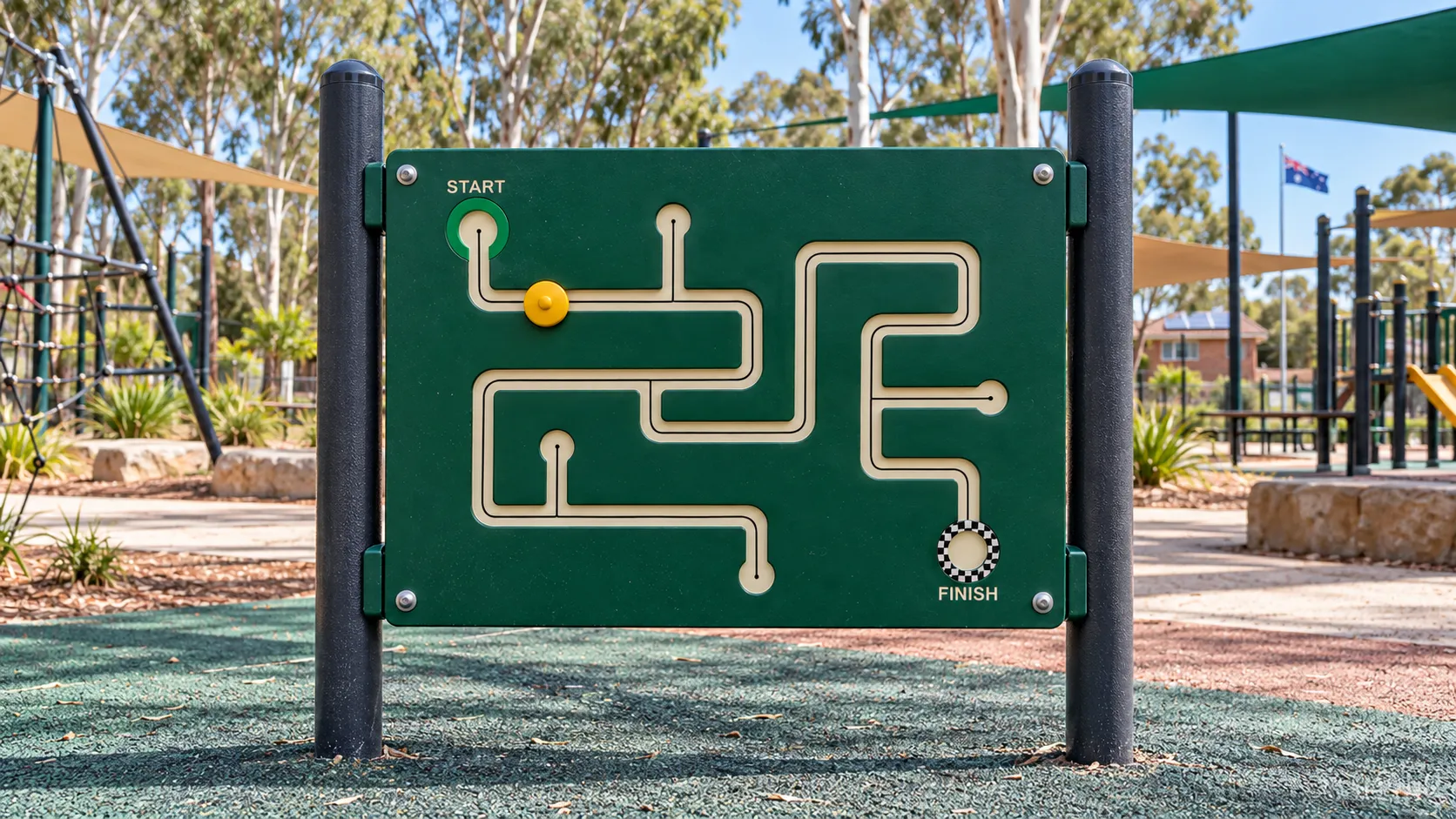
In a hypothetical maze, the finish might sit inside an illustrated area that the movable marker cannot enter. In a matching activity, two symbols might look like a pair but occupy separate tracks that never allow them to meet.
Sliding puzzles need similar scrutiny. A photograph of the completed picture shows what the answer looks like, but it does not prove that the answer can be reached from the starting arrangement. Ask to see the permitted sequence of moves without pieces being removed or repositioned outside normal play.
A supplier demonstration, operating sample or clear video can help resolve these questions. If completion depends on an action unavailable to the child, ask whether the demonstration shows normal play or a separate setup procedure.
How Can Graphics Make a Puzzle Easier to Understand?
A mechanically workable puzzle can still confuse children if its graphics communicate the wrong instructions. The finished design should help users recognise where to begin, what actions are possible and what outcome the activity invites.
Review the artwork as part of the operating system, not merely as decoration. Routes, arrows, symbols and colours can all affect how children interpret an otherwise functional mechanism.
Separate Instructions From Decorative Artwork
Look for the essential information first. Can a child identify the starting point without reading the supplier's catalogue description? Is the movable element obvious? Does the finish look different from the surrounding illustration?
In a hypothetical maze, a decorative winding line might resemble the actual route, encouraging a child to follow a path the marker cannot travel. Similarly, an arrow incorporated into a character illustration could suggest movement in a direction the track does not permit.
Ask to review the graphics at their intended physical size. Small catalogue images can make separate lines blend together or hide weak distinctions between the route and its background. A scaled artwork proof or a view of the finished sample provides a more useful basis for assessment.
Consider the age group using the equipment. Instructions that depend on reading several sentences create a different experience from activities that communicate through recognisable shapes and directional cues. The principles behind choosing age-appropriate preschool equipment are relevant when assessing whether younger users can understand an activity without lengthy explanations.
Not every puzzle needs to be immediately obvious, as discovering a rule can be part of the challenge. The distinction is between deliberate discovery and confusion caused by contradictory information.
Keep Symbols, Routes and Answer Cues Consistent
Check that symbols retain their intended meaning throughout the activity. If a matching puzzle uses outline shapes on one side and filled shapes on the other, the relationship should be intentional and understandable. Accidental differences can make a correct arrangement appear wrong.
Colour can reinforce a rule, but ask whether shape or another visual cue also communicates the relationship. If the instructions require identical symbols, the artwork should not unexpectedly change their orientation or defining details unless recognising that change is part of the challenge.
Answer cues need to match the mechanism as well. A highlighted destination should correspond to a position the piece can reach, numbered steps should follow the permitted sequence and arrows should not imply shortcuts through barriers.
During the design review, ask the supplier to identify the starting cue, action cue and completion cue on the proposed artwork. If decorative elements compete with these features, request clarification before approval rather than relying on staff to explain the activity after installation.
Can the Activity Reset Without Tools or Staff Intervention?
A successful play-through is only part of the assessment. The next question is whether another child can begin playing from the position left by the previous user.
For schools and council sites, repeatability affects how readily an activity can be used throughout the day. A puzzle that regularly needs an adult to restore it may spend time unavailable, even if the initial demonstration works perfectly.
Test the Transition From a Finished Game to a Fresh Start
Ask the demonstrator to complete the activity, leave the pieces where normal play puts them and begin another attempt. This reveals more than a demonstration that starts from a carefully prepared arrangement.
Some puzzles genuinely require a reset. A sliding-picture activity, for example, may need its pieces rearranged before the same challenge can be attempted again. Confirm who can perform that action, how it is communicated and whether it uses movements available during normal play.
A hypothetical maze might allow the marker to travel back along the route, or it might include a clearly identified return path. Either arrangement should be demonstrated rather than inferred from a photograph. If the finish traps the marker in a position from which normal movement cannot release it, the next user's experience differs from the first user's.
Other activities may not have a fixed starting position. A matching task could invite children to form new pairs from whatever arrangement they find. In that case, a formal reset may be unnecessary. Ask the supplier to demonstrate a new interaction starting from the previous user's finishing position.
If resetting requires staff access, mechanical adjustment or removal of a component, ask the supplier to explain the intended operating arrangement. Do not attempt repairs or modifications yourself.
Consider the Positions Left by an Unfinished Attempt
Children will not always complete a puzzle. They may move one piece, change their minds or leave when another activity attracts their attention. The next user should be considered as part of the design assessment.
For a matching activity, ask what happens when several pieces are left away from their matching symbols. Can another child rearrange them normally, or does one piece obstruct another? For a sliding puzzle, check whether ordinary play allows the pieces to return to the intended solution from the resulting arrangement.
A short demonstration cannot establish how every possible position will behave. However, the supplier should explain how the design handles ordinary unfinished play and provide supporting evidence where needed.
This matters in both schools and public playgrounds, where an adult may not be available to prepare equipment between users. Confirm whether restarting requires another person's help, a specific sequence or an adult action that interrupts independent use.
What Product Evidence Should I Request Before Approval?
The strongest evidence connects the proposed design to its actual operation. A photograph can establish appearance, while a full demonstration can reveal movement and restarting. Neither should be treated as proof of something it does not show.
Focus each request on a specific uncertainty. Evidence of a marker reaching its destination, for example, is more useful than an assurance that the puzzle works.
Use a Full Play-Through Rather Than a Single Photograph
A useful demonstration video shows the starting arrangement, permitted movements, completed activity and transition to another attempt. The important actions should remain visible throughout. An edit between a difficult step and the finish leaves that step unverified.
An operating sample provides another opportunity to observe the interaction directly and ask the demonstrator to begin from an unfinished position. Confirm that the sample uses the same tracks, moving elements and artwork as the proposed product. A demonstration of a similar activity does not resolve a question about a different design.
Detailed drawings establish whether routes connect and intended positions exist, particularly when a photograph obscures part of a track. However, artwork alone may not reveal physical movement limits, while a mechanical drawing may not show whether the instructions are understandable.
Match the evidence to the question:
- Reachability: Request a demonstration of the piece travelling to the intended destination through normal movement.
- Graphic clarity: Review the finished-size artwork alongside the physical mechanism.
- Restart behaviour: Request consecutive attempts without an unseen reset or special intervention.
- Unfinished play: Ask the supplier to demonstrate how the activity can be used after an incomplete attempt.
These checks complement the broader assessment of equipment suitability for a school environment while keeping the focus on puzzle functionality.
Confirm That the Reviewed Design Matches the Supplied Version
Customised artwork can alter more than appearance. Replacing a symbol, adding a decorative line or moving a finish label could change the rule a child perceives, even if the underlying mechanism remains unchanged.
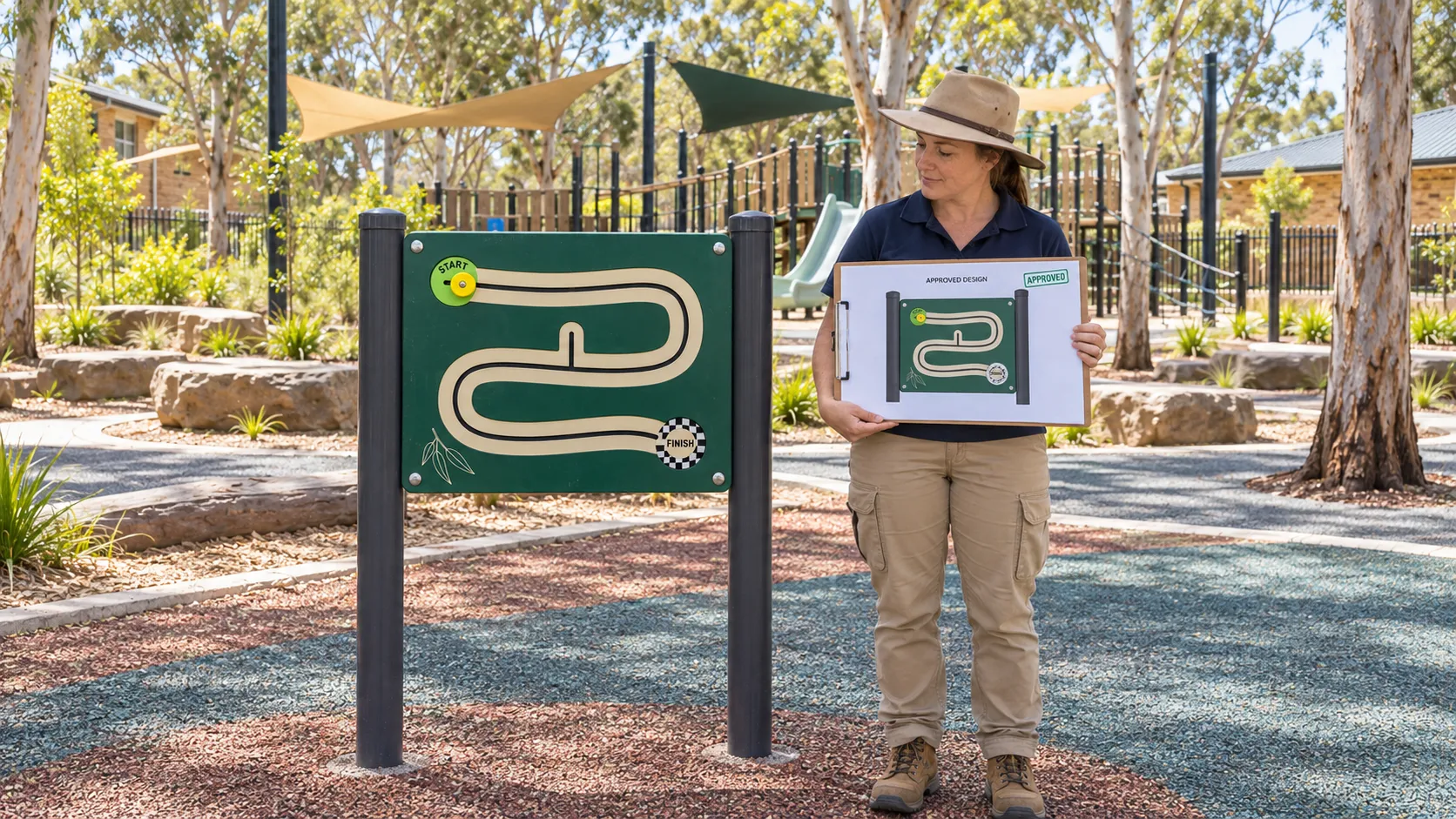
Before approving customisation, ask which graphic elements carry functional meaning and need to remain consistent. A new theme should preserve the relationship between starting cues, routes and answers unless the puzzle is intentionally redesigned and checked again.
When discussing play panels, describe the function that needs to be confirmed. For example, ask whether a marker can reach the illustrated finish through normal movement or whether the activity can restart from the positions left after an incomplete attempt. These questions identify the evidence needed without assuming that a hypothetical design is available.
Record which drawing, sample or demonstration the approval refers to. If the artwork or operating layout changes afterwards, request confirmation that the earlier evidence still applies.
Functional testing should also remain separate from the broader assessment of equipment safety, durability, accessibility and suitability for the intended age group. A puzzle that operates correctly is not automatically suitable for installation in every playground setting.
Use a Practical Checklist Before Approving the Puzzle
Before finalising the selection, confirm that the supplier has addressed the main functional questions about:
- The intended task and successful outcome are clearly defined.
- All required movements are possible during normal play.
- The graphics and instructions match the actual mechanism.
- The activity can be used again after completion or an unfinished attempt, or its reset requirements are clearly explained.
- Demonstrations, drawings or samples relate to the exact proposed design.
- Any required adult intervention or special reset procedure is understood.
- Separate safety, accessibility, durability and age-suitability requirements have been considered.
If any point remains unresolved, request the relevant evidence before approval. A clear explanation backed by a demonstration is more useful than relying on catalogue images or general assurances.
For schools and councils, the aim is to select an activity that delivers the experience its design promises. By checking movement, graphics, repeat use and supporting evidence, purchasers can decide when assessing interactive playground puzzles. Playtec can be included in those discussions by asking specific questions about the proposed play panels and confirming that the reviewed design matches the equipment being considered.


